 Not for sale
🔍 tap the photo to inspect
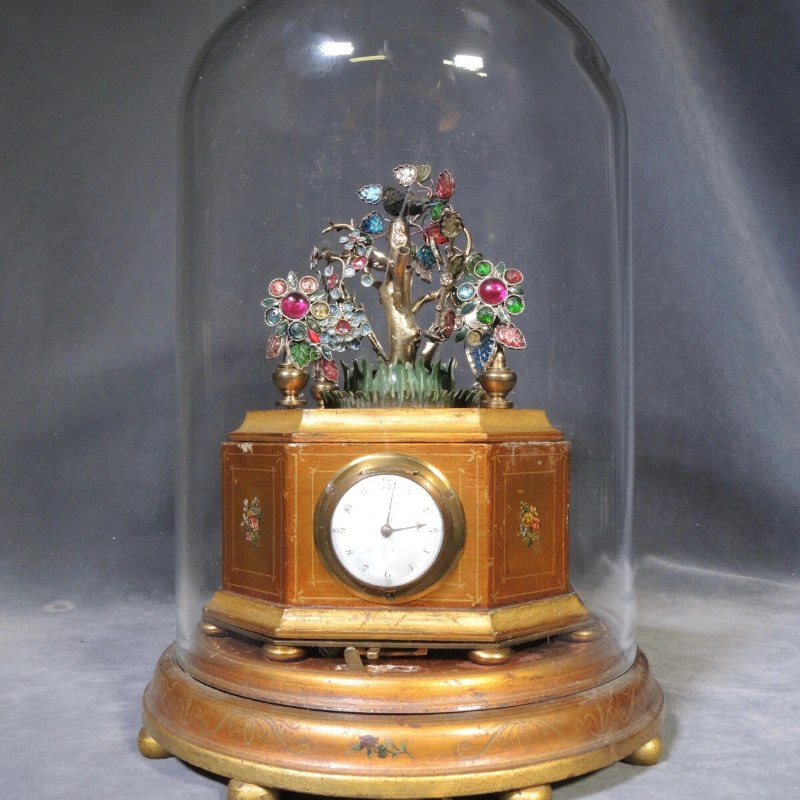
Fusey automaton with a singing bird on gilded wood with rhinestones and a clock “under the dome”Not for sale
This bird is not for sale.
Description
A unique composite item combining an early singing bird fusee automaton, an antique clock and a late 19th century exhibition case. Under the glass dome, on a faceted wooden gilded pedestal with hand-painted floral garlands and arabesques, rises a gilded “jewelry” tree, the branches of which are decorated with foil rhinestones in the form of leaves and flowers in green, blue and ruby tones; the base of the tree is decorated with “grass” made of green glass. At the top is a singing automaton bird, which has preserved the original iridescent feathers of a hummingbird, with a bone beak and a ruby eye.
When launched, the bird turns its body, flaps its wings, turns its head from side to side, opens and closes its bony beak and sings. The mechanism has additional complications beyond those necessary for these movements - evidence that it was originally housed in a much more complex cage with many functions, from which only the mechanism itself has probably survived to this day.
Mechanism
The engine is a fusée (with a chain drive), 1820s, with a circular bellows and an original speed regulator. The tulip stamp and serial number 4 are engraved on the bottom plate. The tulip stamp is associated with the Geneva company Frères Rochat; mechanisms with identical features—circular bellows, whistle tube, and regulator—are reproduced in the seminal study Flights of Fancy (pp. 289–292) among works attributed to Charles Abraham Brugier and dated 1825–1830. On this basis, the present mechanism dates back to the 1820s and is attributed to either Frères Rochat (before 1825) or C. A. Bruguier (after 1825).
Case and watch
At the turn of the 19th and 20th centuries, the mechanism was enclosed in an elegant gilded wooden case with hand painting, created for display of the relic. An antique fusey clock from the early 19th century with a white enamel dial is mounted on the front side of the pedestal; The hour movement, engraved “Elias Grimner, London”, is decorated with a through gilded balance bridge and is preserved in its entirety. The glass dome was subsequently made as an exact reproduction of the lost original - to preserve and display the monument.
Status and Note
The case is in good original condition, with a vibrant patina of gilding and painting. The bird retains the original hummingbird feathers; The mechanism is complete, including the original gilded wood with rhinestones.
Singing bird automatons of this era and class belong to the top of the collectible market, with comparable cells and mechanisms reaching hundreds of thousands and even millions of dollars at international auctions. The present item, bearing the mark “tulip” and serial number 4, is of particular interest as a possible “lost” movement of the large ceremonial cage of the 1820s - a relic of the Genevan school that stood at the origins of the art of mechanical singing birds.
Mechanism passport
| serial number | 4 |
|---|---|
| Dating of the mechanism | 1820s; building: late 19th century; dome: modern reproduction |
| Clock | fusée, early 19th century, engraved “Elias Grimner, London” |
| Materials and technique | brass, gilding, engraving, through metal carving; wood, gilding, hand painting; enamel; rhinestones on foil backing; natural hummingbird feathers; bone; leather; glass |
| Dimensions | assembled height - 29 cm; base diameter - 20 cm |